Introduction
This guide provides a thorough understanding of community emergency fuel cache best practices. Readers will learn how to assess storage needs, select compliant containers, and implement safety measures. The article references highly rated products that enhance reliability and ease of use. By following the recommendations, communities can improve preparedness while adhering to regulatory standards.
Background and Context
Fuel is a critical resource during power outages, natural disasters, and other emergencies. Improper storage can lead to leaks, fires, or environmental contamination. Federal agencies such as OSHA and NFPA define safety requirements for flammable liquids. Understanding these standards is essential before establishing a community cache.
Assessing Fuel Storage Needs
The first step is to estimate the volume of gasoline required for generators, lawn equipment, and vehicles. Communities often allocate between 10 and 20 gallons per household, resulting in total capacities of 100‑200 gallons for small neighborhoods. Selecting containers that balance capacity with portability reduces handling difficulty. It is also important to consider the storage environment, including temperature fluctuations and exposure to sunlight.
Choosing Appropriate Containers
Containers must meet OSHA Standard 1910.106 and NFPA Code 30. Metal cans provide superior durability, while plastic models may be lighter but can suffer from cracking. The following products exemplify best‑in‑class options.
The Eagle 5‑Gallon Gas Can offers a 5‑gallon capacity, 24‑gauge hot‑dipped galvanized steel construction, and a flame arrestor. Its self‑closing lid and non‑sparking brass spout meet FM, UL, and ULC approvals, earning a 4.7‑star rating from over 8,200 reviewers. The can’s powder‑coat finish resists scratches and corrosion, making it suitable for long‑term outdoor storage.
The No‑Spill 2.5‑Gallon Gas Can provides a smaller, 2.5‑gallon option for chainsaws and handheld equipment. Its thumb‑button control and integrated stainless‑steel screen enable precise pouring without over‑filling. Reviewers note the sturdy construction and effective spill‑proof design, reflected in a 4.6‑star rating from more than 10,000 customers.
For users who prefer a Type II design with self‑venting capability, the SureCan 5‑Gallon Utility Can combines a rotating spout with an ergonomic thumb trigger. The self‑venting mechanism reduces splashing, while the double O‑ring seal prevents leaks. Although priced at $76.50, its durability and three‑year warranty justify the investment for high‑use scenarios.
The Scepter 5‑Gallon Gas Can features a SmartControl spout that allows users to modulate flow with minimal hand strength. An integrated air vent supports rapid fills up to three gallons per minute. With a 4.3‑star rating and EPA/ CARB compliance, it offers a balance of safety and convenience for community members of varying physical ability.
Implementing a Flammable Storage Cabinet
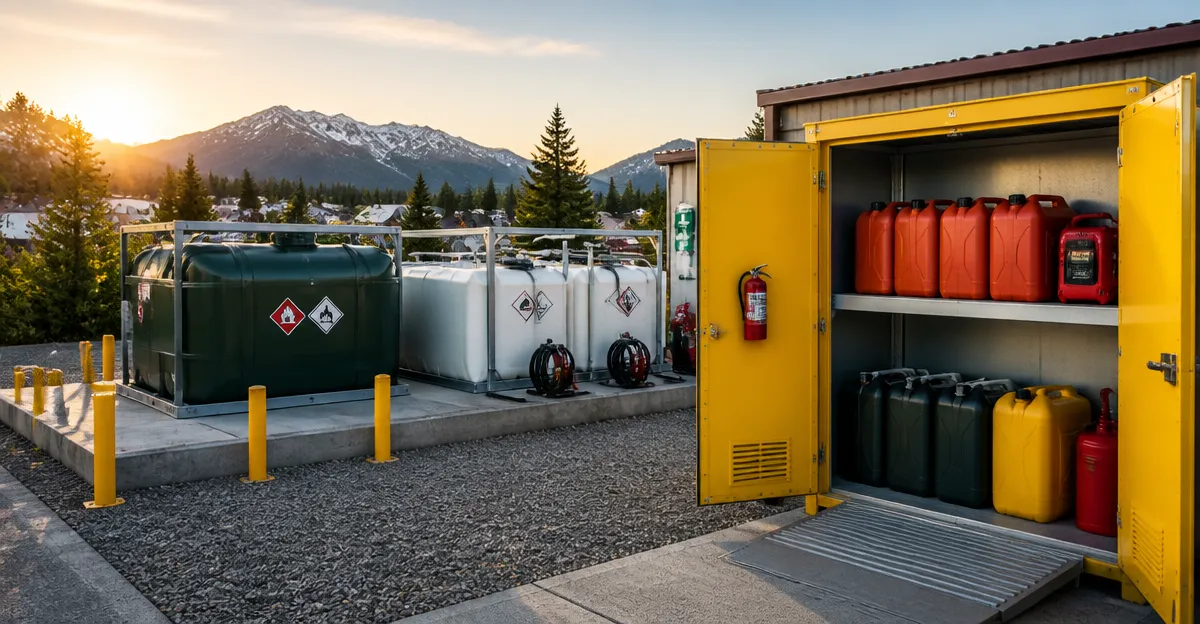
Storing multiple containers together requires a fire‑resistant enclosure. The VEVOR Flammable Storage Cabinet delivers a 12‑gallon capacity with adjustable galvanized steel shelves. Constructed from Q235 cold‑rolled steel, the cabinet includes a three‑point locking system and spill containment tray, meeting industrial safety expectations. Reviewers highlight its sturdy build and suitability for storing both gasoline cans and lithium‑polymer batteries.
When positioning the cabinet, maintain a minimum of three feet from heat sources and ensure proper ventilation to dissipate vapors. The cabinet’s ventilation openings on both interior and exterior surfaces reduce vapor accumulation, aligning with NFPA recommendations. Grounding conductors further mitigate static discharge risks.
Maintenance and Inspection
Regular inspection of containers and cabinets prevents degradation that could lead to leaks. Check seals, gaskets, and vent mechanisms monthly, especially after extreme temperature changes. Replace any damaged components promptly; many manufacturers, such as SureCan, offer inexpensive replacement parts.
Maintain an inventory log that records purchase dates, inspection results, and fuel treatment additives. Adding a fuel stabilizer, such as ethanol‑free treatment, extends gasoline life up to twelve months, reducing the need for frequent rotation.
Regulatory Compliance and Safety Standards
Compliance with local fire codes often requires labeling of flammable storage areas and posting of emergency contact numbers. Ensure that each container displays the appropriate hazard symbols and that the cabinet bears a visible compliance label.
When establishing a community cache, obtain any necessary permits from municipal authorities. Documentation should include the total volume of stored fuel, the type of containers used, and the location of the storage cabinet. Conduct a fire drill annually to familiarize participants with safe retrieval procedures.
Comparison and Selection Guide
| Product | Capacity | Material | Key Safety Feature | Price (USD) | Rating |
|---|---|---|---|---|---|
| Eagle 5‑Gallon Gas Can | 5 gal | 24‑gauge galvanized steel | Flame arrestor, self‑closing lid | 64.98 | 4.7 |
| No‑Spill 2.5‑Gallon Gas Can | 2.5 gal | Rigid plastic with stainless steel screen | Thumb‑button pour control | 26.89 | 4.6 |
| SureCan 5‑Gallon Utility Can | 5 gal | High‑impact polymer | Self‑venting Type II, rotating spout | 76.50 | 4.6 |
| Scepter 5‑Gallon Gas Can | 5 gal | 5‑layer polymer construction | SmartControl flow control | 41.11 | 4.3 |
| VEVOR Flammable Storage Cabinet | 12 gal (internal) | Cold‑rolled steel, galvanized shelves | Three‑point lock, spill tray | 169.90 | 4.4 |
Communities with limited space may prefer the compact No‑Spill can for handheld tools, while larger operations benefit from the Eagle or SureCan cans paired with the VEVOR cabinet. Price considerations should be weighed against durability and compliance features.
Best Practices & Tips
- Store fuel in a cool, well‑ventilated area away from direct sunlight.
- Use fuel stabilizers when storing gasoline for longer than three months.
- Label each container with purchase date and intended use.
- Rotate stock every six months to ensure freshness.
- Secure containers inside a fire‑rated cabinet and lock the cabinet when not in use.
- Train community volunteers on proper pouring techniques and emergency shut‑off procedures.
- Conduct quarterly leak checks using a soap‑solution test on all seals.
Frequently Asked Questions
- What is the maximum amount of gasoline a community can legally store? Regulations vary by jurisdiction, but many fire codes limit on‑site storage to 25 gallons per household without a special permit. Larger caches typically require a fire‑rated cabinet and official approval.
- Can plastic containers be used for long‑term storage? Plastic cans are acceptable if they meet UL and NFPA standards, but they are more prone to cracking over time. Metal containers such as the Eagle 5‑Gallon Gas Can provide superior durability.
- How often should the vent mechanisms be inspected? Vent systems should be examined at least once per month and after any significant temperature swing to ensure they are not obstructed.
- Is a fuel stabilizer necessary for a community cache? Adding a stabilizer extends gasoline life and reduces the risk of gum formation, which is especially important for caches intended to last six months or longer.
- What fire‑extinguishing equipment should accompany the storage area? A Class B fire extinguisher rated for flammable liquids should be mounted within easy reach of the cabinet.
- Can the VEVOR cabinet store both gasoline cans and battery packs? Yes, the cabinet’s adjustable shelves accommodate various container sizes, and the grounding conductor helps mitigate static discharge from lithium‑polymer batteries.
- How should a leak be addressed if discovered? Immediately isolate the affected container, ventilate the area, and transfer the fuel to a compliant container. Report the incident to local fire authorities and replace the compromised can.
Conclusion
Effective community emergency fuel caches rely on proper assessment, compliant containers, and secure storage solutions. By selecting products such as the Eagle 5‑Gallon Gas Can, No‑Spill 2.5‑Gallon Gas Can, SureCan Utility Can, Scepter 5‑Gallon Gas Can, and the VEVOR Flammable Storage Cabinet, communities can achieve safety, durability, and regulatory compliance. Ongoing maintenance, regular inspections, and clear emergency procedures ensure that the stored fuel remains a reliable resource when needed.
Products Featured in This Guide
Eagle 5‑Gallon Gas Can
Price: $64.98 | Rating: 4.7/5 (8,230 reviews)
Featured for its UL/ULC/FM approvals, flame arrestor, and robust galvanized steel construction, making it ideal for long‑term community storage.
No‑Spill 2.5‑Gallon Gas Can
Price: $26.89 | Rating: 4.6/5 (10,282 reviews)
Featured for its precise thumb‑button pour control and built‑in stainless‑steel screen, providing a compact solution for handheld equipment.
SureCan 5‑Gallon Utility Can
Price: $76.50 | Rating: 4.6/5 (1,458 reviews)
Featured for its rotating spout, self‑venting Type II design, and three‑year warranty, offering superior control for high‑use scenarios.
VEVOR Flammable Storage Cabinet
Price: $169.90 | Rating: 4.4/5 (235 reviews)
Featured for its fire‑resistant steel construction, three‑point lock, and spill containment tray, providing a secure hub for multiple fuel containers.
Scepter 5‑Gallon Gas Can
Price: $41.11 | Rating: 4.3/5 (3,517 reviews)
Featured for its SmartControl spout that allows low‑strength users to regulate flow, making it accessible for a broad range of community members.