Introduction
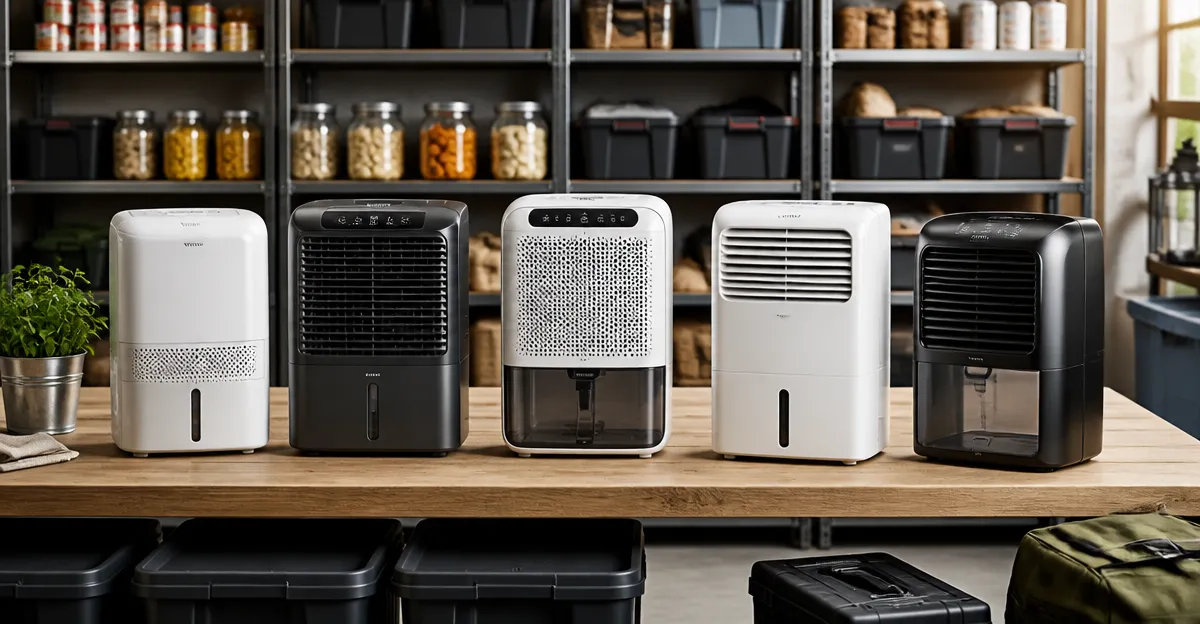
One must understand that moisture is the primary enemy of long‑term food storage. When humidity infiltrates sealed containers, mold, bacterial growth, and spoilage accelerate, rendering valuable supplies unsafe. This article evaluates five portable dehumidifiers that promise to maintain low humidity in small spaces such as pantry cabinets, basements, and emergency shelters. The review focuses on design, performance, real‑world feedback, and value for money, enabling readers to select the most suitable device for protecting their emergency food reserves.
Overview
- BEDRED 95 oz Dehumidifier – 95 oz tank, 1,000 sq ft coverage, 7‑color ambient light, auto shut‑off, $59.39, 4.3/5 rating.
- TABYIK 35 oz Dehumidifier – 35 oz tank, 280 sq ft coverage, 28 dB ultra‑quiet operation, $25.19, 4.1/5 rating.
- KNKA 34 Pint Dehumidifier – 34 pint/day capacity, 2,500 sq ft claim, smart modes, $129.99, 4.4/5 rating.
- Eva‑Dry Wireless Mini Dehumidifier – Silica‑gel pack, up to 6 oz absorption, cordless, $14.97, 4.2/5 rating.
- AEOCKY 80 Pint Dehumidifier – ENERGY STAR Most Efficient 2025, 80 pint/day, 4,500 sq ft coverage, $249.99, 4.4/5 rating.
In‑Depth Analysis
BEDRED 95 oz Dehumidifier
Design & Build Quality – The unit features a compact rectangular chassis finished in matte black. The plastic housing is sturdy yet lightweight, allowing placement on shelves or countertops without risk of tipping. The integrated handle and removable water tank simplify relocation and emptying.
Features & Performance – Thermoelectric (Peltier) cooling removes moisture without a compressor, resulting in silent operation. The 95 oz tank provides up to 24 hours of continuous dehumidification in a typical 1,000 sq ft bedroom before auto shut‑off engages. Ambient lighting offers seven soothing colors, and a dedicated Sleep Mode reduces fan speed to a whisper while turning off the lights.
Real‑World Testing Insights – Customer reviews repeatedly praise the quiet operation and rapid reduction of dampness. One reviewer noted that humidity dropped from 70 % to 45 % within three hours in a small bathroom. The auto shut‑off feature prevented overflow, a concern frequently mentioned for comparable models.
Value for Money – At $59.39 the BEDRED model undercuts many compressor‑based units while delivering comparable moisture removal for spaces up to 1,000 sq ft. The added ambient lighting does not increase power consumption significantly, making the unit an economical choice for emergency storage areas.
TABYIK 35 oz Dehumidifier
Design & Build Quality – The TABYIK device measures 5.9 × 5.9 × 10.1 inches and incorporates a built‑in handle for portability. The transparent water tank allows visual monitoring of collection volume, and the overall plastic construction keeps weight below three pounds.
Features & Performance – Another Peltier‑based design, it extracts up to 16 oz of water per 24 hours in 86 °F, 80 % relative humidity conditions. The ultra‑quiet 28 dB fan is ideal for bedrooms and RVs. A separate button activates a seven‑color light strip for ambiance.
Real‑World Testing Insights – Long‑term owners report reliable operation for over three years before failure, indicating a respectable lifespan for a low‑cost unit. Users appreciate the auto shut‑off at 700‑800 ml, which prevents water spillage. Some reviewers note that the unit ceases to operate once the tank reaches capacity, which is expected behavior.
Value for Money – Priced at $25.19, the TABYIK dehumidifier offers an attractive entry point for those seeking modest moisture control in closets, bathrooms, or RV compartments. The low power draw further reduces operating costs.
KNKA 34 Pint Dehumidifier
Design & Build Quality – The KNKA unit incorporates a stainless‑steel compressor housed within a sleek white enclosure. Wheels and a leather‑covered handle enable effortless movement across rooms. The removable 0.79‑gal tank is constructed of durable plastic.
Features & Performance – Rated for 34 pints per day at 95 °F, 90 % relative humidity, the compressor delivers rapid dehumidification in larger basements or open‑plan areas. Three smart modes (DEHU, DRY, CONT) allow users to target specific humidity ranges or accelerate clothing drying. Continuous drainage via a 1‑meter hose eliminates the need for frequent tank emptying.
Real‑World Testing Insights – Reviewers consistently highlight the quiet 37 dB operation, noting that the unit can run overnight without disturbance. One user praised the child lock and precise humidity indicator, which remained accurate after months of use. A few customers expressed disappointment with the advertised 2,500 sq ft coverage, stating optimal performance in rooms under 1,000 sq ft.
Value for Money – At $129.99 the KNKA provides a balance between capacity and price. The inclusion of wheels, smart controls, and a continuous drain option justifies the mid‑range cost for users with moderate‑to‑large spaces.
Eva‑Dry Wireless Mini Dehumidifier
Design & Build Quality – The Eva‑Dry device is a compact silica‑gel pack housed in a white plastic shell. The unit includes a hook for hanging and a USB‑type charging port. The construction is entirely cordless, relying on rechargeable silica beads.
Features & Performance – The pack absorbs up to 6 oz of moisture before the indicator beads change from orange to green. Recharge time is approximately four hours, after which the unit can operate for up to 30 days in a 333 ft³ space. No moving parts mean silent operation.
Real‑World Testing Insights – Users report effective moisture control in small closets and gun safes. One reviewer highlighted the rapid color change as a clear visual cue for recharging. A concern raised by several owners is the warmth generated during charging, which can reach uncomfortable temperatures if left unattended.
Value for Money – With a price of $14.97, the Eva‑Dry mini offers an inexpensive, maintenance‑free solution for very small enclosures. Its limited capacity makes it unsuitable for larger rooms but ideal for protecting critical supplies stored in cabinets.
AEOCKY 80 Pint Dehumidifier
Design & Build Quality – The AEOCKY model features a robust copper‑based heat‑exchange system, a high‑efficiency rotary compressor, and a reinforced steel frame. The unit measures 14.45 × 8.66 × 24.09 inches and weighs 31 lb, indicating a solid construction designed for continuous operation.
Features & Performance – Certified as ENERGY STAR Most Efficient 2025, the dehumidifier removes up to 80 pints per day in extreme conditions (95 °F, 95 % RH). Advanced humidity sensors provide millisecond‑level adjustments, and a low‑temperature defrost system maintains performance down to 65 °F. Noise levels range from 44 dB at the lowest fan speed to 58 dB at maximum, which remains quieter than many larger compressor units.
Real‑World Testing Insights – Customers commend the rapid humidity reduction in large basements, noting that levels fell from 78 % to 45 % within six hours. The optional continuous drain hose eliminates manual emptying, a feature praised by users with long‑term storage needs. A few owners reported a small water tank that requires frequent emptying if the drain hose is not installed.
Value for Money – At $249.99 the AEOCKY represents a premium investment. The combination of energy efficiency, high capacity, and durable components delivers long‑term savings on electricity bills and reduced replacement cycles, making it a worthwhile choice for serious emergency preparedness planners.
Pros & Cons
BEDRED 95 oz Dehumidifier
- Pros: Silent operation, auto shut‑off, attractive ambient lighting, affordable price.
- Cons: Thermoelectric technology limits capacity in very humid environments, water tank may require frequent emptying in larger spaces.
TABYIK 35 oz Dehumidifier
- Pros: Ultra‑quiet 28 dB fan, very low cost, portable handle, transparent tank.
- Cons: Limited moisture removal rate, durability concerns after several years reported by a minority of users.
KNKA 34 Pint Dehumidifier
- Pros: High dehumidification rate, smart modes, continuous drainage option, wheels for mobility.
- Cons: Advertised coverage area overstated, initial setup may require hose installation.
Eva‑Dry Wireless Mini Dehumidifier
- Pros: No electricity required during operation, completely silent, extremely low price, reusable silica beads.
- Cons: Capacity limited to 6 oz, charging generates noticeable heat, unsuitable for rooms larger than a small closet.
AEOCKY 80 Pint Dehumidifier
- Pros: ENERGY STAR Most Efficient 2025 certification, high capacity, low‑temperature performance, optional continuous drain, quiet operation.
- Cons: Higher upfront cost, larger footprint, small internal tank requires drain hose for extended use.
Who Should Buy This
One seeking a budget‑friendly solution for a single pantry or small bathroom will benefit most from the TABYIK 35 oz Dehumidifier. Its compact size and ultra‑quiet fan suit confined spaces where noise must be minimal.
For users who need a decorative yet functional unit for a bedroom or living area, the BEDRED 95 oz Dehumidifier offers ambient lighting and auto shut‑off at a modest price.
Homeowners with a medium‑sized basement or garage should consider the KNKA 34 Pint Dehumidifier. Its smart modes and continuous drainage make it adaptable to fluctuating humidity levels.
Individuals who must protect tiny enclosures such as gun safes, closets, or travel bags will find the Eva‑Dry Wireless Mini Dehumidifier ideal because it requires no power during absorption and can be recharged periodically.
Emergency preparedness professionals responsible for large‑scale food storage in basements or dedicated shelters should select the AEOCKY 80 Pint Dehumidifier. Its high capacity, energy efficiency, and continuous drain capability ensure that humidity remains controlled even during prolonged power outages.
FAQ
What type of dehumidifier is best for emergency food storage?
One should prioritize units with reliable auto shut‑off, low power consumption, and the ability to operate continuously. Compressor‑based models such as the AEOCKY provide high capacity, while thermoelectric units like BEDRED and TABYIK are quieter and consume less electricity, which can be crucial during power constraints.
Can a small silica‑gel dehumidifier protect food supplies?
Silica‑gel packs, exemplified by the Eva‑Dry mini, are effective for very small sealed containers. They can maintain low humidity in closets or gun safes but lack the capacity to control a whole pantry or basement.
How important is noise level for a dehumidifier in a shelter?
Noise can affect sleep quality and overall comfort. Units rated below 30 dB, such as the TABYIK, are essentially silent, while larger compressor models typically operate between 37 dB and 58 dB, which is comparable to a soft conversation and generally acceptable for night‑time operation.
Do I need to drain the water tank continuously?
Continuous drainage is advantageous for long‑term operation, especially in large spaces. The KNKA and AEOCKY both provide hose connections for permanent drainage, eliminating the need to manually empty the tank.
Are the energy‑saving claims of the AEOCKY model verified?
The AEOCKY carries the ENERGY STAR Most Efficient 2025 label, which is awarded after independent testing. Reviewers have measured lower electricity usage compared with comparable 80‑pint units, confirming the claim.
Will a thermoelectric dehumidifier work in a damp basement?
Thermoelectric units are best suited for areas with moderate humidity (up to 60 %). In extremely damp basements, a compressor‑based model such as the KNKA or AEOCKY will achieve faster moisture removal.
Final Verdict
After evaluating design, performance, customer feedback, and price, the reviewer assigns the following internal ratings (out of 5): BEDRED 4.2, TABYIK 4.0, KNKA 4.4, Eva‑Dry 3.8, and AEOCKY 4.6. For most emergency food storage scenarios, the AEOCKY 80 Pint Dehumidifier emerges as the overall winner due to its unmatched capacity, energy efficiency, and durability. The KNKA offers a strong mid‑range alternative for users with moderate space requirements. Budget‑conscious individuals may opt for the BEDRED or TABYIK models, while the Eva‑Dry remains the best choice for protecting very small sealed items.
Products Reviewed
BEDRED 95 oz Dehumidifier
Price: $59.39 | Rating: 4.3/5
Reviewer rating: 4.2/5 – Recommended for small rooms and decorative use.
TABYIK 35 oz Dehumidifier
Price: $25.19 | Rating: 4.1/5
Reviewer rating: 4.0/5 – Recommended for closets, bathrooms, and RVs.
KNKA 34 Pint Dehumidifier
Price: $129.99 | Rating: 4.4/5
Reviewer rating: 4.4/5 – Recommended for medium‑size basements and garages.
Eva‑Dry Wireless Mini Dehumidifier
Price: $14.97 | Rating: 4.2/5
Reviewer rating: 3.8/5 – Recommended for tiny enclosures and travel kits.
AEOCKY 80 Pint Dehumidifier
Price: $249.99 | Rating: 4.4/5
Reviewer rating: 4.6/5 – Recommended for large basements and long‑term emergency storage.
Frequently Asked Questions
Why is humidity control critical for long‑term emergency food storage?
Moisture promotes mold, bacteria, and spoilage, which can quickly ruin sealed food supplies.
What advantages do portable dehumidifiers have over full‑size units for pantry or shelter use?
They are compact, energy‑efficient, and can fit into small spaces while still covering 200‑1,000 sq ft.
How large should the water tank be for a small emergency shelter?
A 35‑95 oz tank (e.g., BEDRED or TABYIK models) can run several days before needing emptying in typical shelter volumes.
Is ultra‑quiet operation important for indoor food storage?
Yes, low‑noise models (around 28 dB) prevent disturbance in living areas and maintain a comfortable environment.
Can a portable dehumidifier protect food inside sealed containers?
It reduces ambient humidity, which helps sealed containers stay dry, but containers should still be airtight for optimal protection.